
Canadian County Most Wanted List
The Canadian County Sheriff's Office Most Wanted page is the place to start. Filters let you narrow the roster by race, sex, eye and hair color, bond amount, aliases, last known location, and what a person is wanted for. CCSO updates the list on a routine schedule rather than in real time, and the office cautions that entries may lag behind actual warrant status. Bond figures can be rough estimates too. Treat the page as a snapshot, not a warrant file.
Entries change fast. Someone can be added, recalled, or flagged as arrested shortly after you view the list, so the live page is the only reliable record. When it displays an updating message, results may still sit behind the agency's search tool. No fixed count belongs on a permanent page for that reason. The CCSO Most Wanted interface shown here reflects that official source.
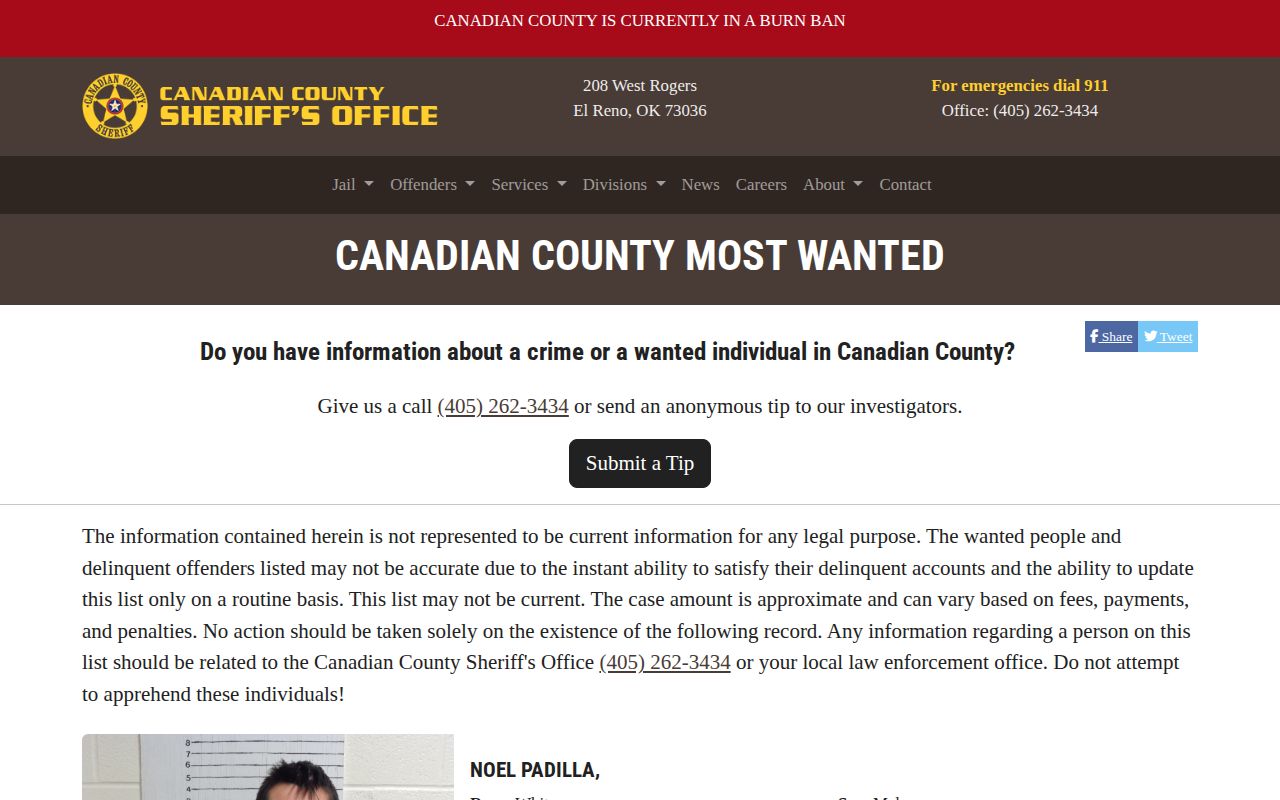
The agency interface is best checked at the sheriff's own site, where live status and warnings stay attached to the data rather than stranded in a copy.
Safety notice: Never contact, follow, or try to apprehend anyone shown on a Canadian County wanted page, and report immediate danger through 911 or non-emergency tips to CCSO.
Canadian County Wanted Listing Fields
Each wanted listing exists to help CCSO identify a person and keep agency details organized. The fields can separate two people with similar names. They can also fall out of date between routine page updates. So treat the listing as a starting point. Compare details only through the official entry, and take any legal status question to the court or the issuing office.
| Official field | How CCSO uses it |
|---|---|
| Name and alias | Identifies the published subject and alternate names in the agency record. |
| Status and date added | Shows the page's record status and timing, subject to routine updates. |
| Type and wanted-for text | Describes the agency's wanted entry, not a final court disposition. |
| Physical description | May include race, sex, eye color, and hair color filters. |
| Last known location | An agency lead, not an invitation for private contact. |
| Bond, charges, and summary | Context that can be approximate or later changed by a court. |
The list's visuals separate active entries from recalled-warrant and arrested-warrant notices. Always read the current status first. A photo on the live sheriff page is context for a tip, nothing more.
Check Canadian County Wanted Records Safely
The official list has a narrow, safety-minded purpose. It helps a reader recognize a sheriff publication and pass useful information to the agency. It grants no authority for private enforcement. It also cannot settle every warrant question, since CCSO picks what to publish and warns the page may be in flux.
- Open the official CCSO Most Wanted page and review its current disclaimer before relying on a name, image, or status.
- Use the available filters carefully. Similar names and changing details require confirmation through the issuing office.
- When information may help law enforcement, use the CCSO tip channel or call 911 for an immediate emergency. Never approach a listed person.
- After an arrest or surrender, check the county booking tools through the Canadian County booking record search for custody status. A booking result is still an charge, not a conviction.
This is not a booking feed. Someone on the wanted list may have no current Canadian County booking entry at all. Flip it around, and a person sitting in the jail roster may never appear on the wanted list. Treat warrant status and detention status as two separate questions.
Canadian County Wanted Tips
CCSO offers an official investigator tip form for information on wanted individuals. Crimes in progress should go through 911 or a deputy at (405) 262-3434 instead. The form allows an anonymous submission or a request for contact, and it asks for specifics like location, vehicle, and time. It also warns that filing a false report is illegal. No reward program or Crime Stoppers payment is promised anywhere official, so assume there is none.
A tip form is not the way to correct a record, dispute an identity, or argue a case result. Those matters belong with CCSO Records, the court, or an attorney. Give the agency only details that help it assess the report, and leave any direct contact with a listed person to trained officers.
Canadian County Warrant Check
A public wanted list and a warrant check are two different things. One is a curated agency page with filters and a routine-update warning. The other is an official legal process that can be issued, recalled, served, or changed. Start with the issuing court or CCSO when you have a question about a specific person. Mustang has a city-linked warrant path, though it cannot replace confirmation from the Canadian County court or sheriff.
- Identify the likely issuing jurisdiction, name, and date range. Do not assume a Canadian County listing answers a state or federal question.
- Check the official CCSO page for a current published entry, while observing its routine-update caution.
- Search OSCN for a related Canadian County case and compare dates, case number, and filings.
- Contact the court clerk or CCSO for confirmation when a legal status matters. Canadian County Court Clerk is at 301 N. Choctaw, El Reno, (405) 295-6100.
- To resolve an active warrant, speak with an attorney or the court and follow the office's instructions. Do not seek to evade service or depend on unofficial posts.
CCSO's currentness warning deserves special weight here. The public wanted page can lag behind a real change, and a court docket has its own publication limits. For a personal question, direct official confirmation is the safest route.
Canadian County Warrant Terms
Warrant labels can sound alike. They do very different jobs. The source material offers no complete local warrant taxonomy, so the distinctions here only sketch the basic record path, not any prediction about a person. The charging court and the warrant issuer control the actual status.
| Term | Record question it raises |
|---|---|
| Arrest warrant | Whether a court or authorized process directs an arrest based on an charge. |
| Bench warrant | Whether a court has issued an order connected to a pending case or required appearance. |
| Wanted entry | Whether CCSO has chosen to display a person on its public page; it is not every warrant. |
| Recall or arrested status | Whether the agency page shows a changed status that should be confirmed with the issuer. |
A term on a sheriff page is not a court decision. An arraignment is an early proceeding. Charges may be addressed there. The disposition is the later outcome. Those stages are exactly why the court record matters, even when an agency page names a specific charge.
Canadian County Warrant Updates
Give the Canadian County Sheriff's Office wanted list a second look before you act on anything. Its public page has shown a maintenance notice at times, even while the underlying records were still live. Treat that mixed signal with care. Go back to the official page yourself. If a name or a warrant matters to you, call the office that issued it. That call beats any count you might see quoted elsewhere.
Searching on the go? The County of Canadian's official app offers inmate lookup and a way to submit tips. Nothing in its store listing promises warrant alerts or a separate photo policy, so don't assume those exist. The sheriff's social accounts can add useful updates, but none of them replaces the official roster. Rank your sources this way: the wanted list first, then the court docket, then direct confirmation from the agency itself. A booking record and a wanted entry are different animals. Only the court docket shows how a case actually ends.